

PVC roof membrane vs TPO in Houston explained clearly
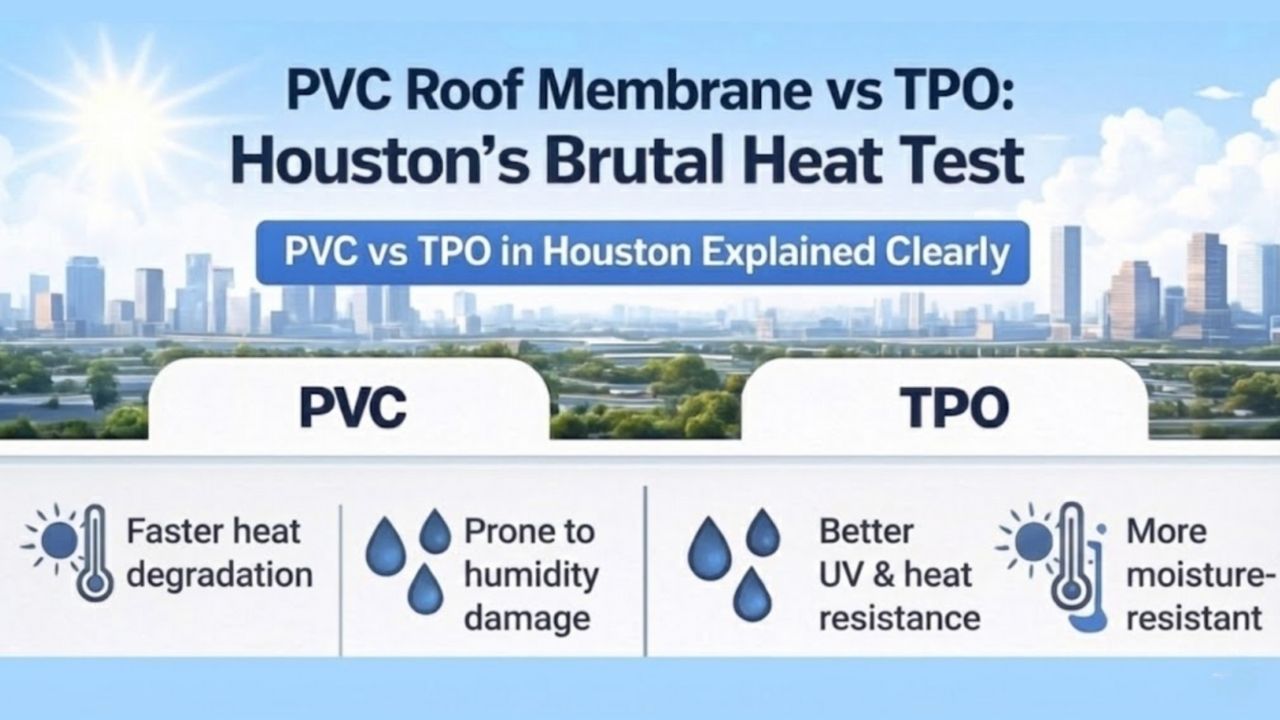
PVC roof membrane vs TPO in Houston explained clearly starts with one reality Houston owners can’t ignore: TPO has become the stronger, more cost-efficient, longer-lasting roofing choice for most Houston buildings because it handles heat, UV, and long-term aging better than PVC.
Commercial Roof Repair Solutions explains why TPO delivers more value, less risk, and better lifespan in real Houston conditions.
Key Takeaways
- Houston heat exposes weaknesses PVC can’t hide
- UV performance favors modern TPO formulations
- Cost and lifespan tilt heavily toward TPO
- Storm resilience improves with TPO assemblies
How Houston Heat Makes PVC vs TPO a Big Decision
How Houston heat makes PVC vs TPO a big decision comes down to how each membrane reacts to months of 150-degree rooftop temperatures. Older advice paints PVC as the more heat-resistant option, but modern TPO compounds built for hot climates consistently outperform PVC in Houston’s extreme heat cycles.
Commercial Roof Repair Solutions sees it in the field every year: updated TPO formulas maintain flexibility longer, resist heat-driven shrinkage better, and avoid the brittle cracking that shows up in aging PVC sheets baked under Gulf Coast sun.
Why Houston UV Exposure Favors Modern TPO
Why Houston UV exposure favors modern TPO is tied to formulation evolution. Early TPO products had a reputation for rigidizing under heavy UV, but today’s high-grade TPO membranes are engineered specifically for high-sun markets like Houston.
TPO now typically shows:
- Slower UV-driven aging
- Lower surface oxidation rates
- Better flexibility retention
- Stronger resistance to heat cycling damage
PVC still handles UV well, but it doesn’t improve with temperature the way advanced TPO compounds do. Houston’s sunlight hits roofs nonstop, and TPO is now designed for exactly that environment.
Why TPO Outperforms PVC in Chemical and Polluted Environments
Why TPO outperforms PVC in chemical and polluted environments surprises some owners because PVC has long been marketed as the chemical-resistant option. But in Houston, most rooftop “chemical exposure” is not industrial solvent contact. It’s soot, pollution, condensate, and airborne particulates.
TPO handles these conditions extremely well because:
- It resists surface softening
- It doesn’t absorb contaminants
- It cleans easily without harsh agents
- It doesn’t degrade when scrubbed
PVC still performs better when rooftops see heavy grease or oil exhaust, like restaurants and food processing. But for 90 percent of Houston roofs, TPO’s resistance to pollution, runoff, and aggressive cleaning agents is more than enough.
How Houston Storm Cycles Give TPO an Edge
How Houston storm cycles give TPO an edge becomes clear during hurricane season. Wind uplift forces, pressure changes, and driven rain test membrane strength and attachment patterns. TPO assemblies benefit from thicker reinforcement scrims and stronger sheet rigidity, both of which increase resistance to pull-off and seam strain under high wind events.
PVC welds are strong, but PVC sheets are softer and more prone to deformation during large-scale wind events. TPO’s stiffer structure performs better across wide spans, especially on large commercial roofs.
Why Heat Weld Control Makes TPO More Reliable
Why heat weld control makes TPO more reliable comes from how predictable TPO welding has become with modern equipment. Ten years ago, installers struggled with TPO weld sensitivity on 150-degree rooftops. Today, updated welders and improved membrane formulations create consistent, high-strength seams even in brutal summer heat.
PVC welds quickly, but its soft composition can lead to:
- Overburning
- Membrane thinning
- Reduced long-term tensile strength
TPO welds deliver stronger, more uniform seams when installed by trained crews.
Why Reflectivity Makes TPO the Long-Term Winner
Why reflectivity makes TPO the long-term winner comes down to the fact that TPO’s surface chemistry maintains reflectivity better through repeated Houston heat cycles.
PVC tends to:
- Accumulate dirt faster
- Lose reflectivity sooner
- Require more aggressive cleaning
- Experience surface softening over time
TPO stays bright longer, holds its solar reflectance, and reduces heat load on HVAC equipment. That’s a real operational savings for Houston owners.
How Houston Humidity Affects PVC and TPO Differently
How Houston humidity affects PVC and TPO differently comes down to structural moisture absorption. PVC can weaken faster in humidity and ponding conditions because its material composition is more sensitive to water infiltration over time.
TPO typically:
- Resists humidity-driven degradation better
- Holds reinforcement strength longer
- Maintains membrane rigidity in wet cycles
- Performs better on low-slope roofs with drainage issues
PVC can do well in controlled environments, but Houston roofs rarely enjoy perfect drainage.
Why Foot Traffic and Mechanical Damage Favor TPO
Why foot traffic and mechanical damage favor TPO is simple: TPO is tougher. Its reinforced core and surface hardness allow it to handle heavy rooftop activity without tearing, denting, or gouging.
Houston roofs see constant technician access:
- HVAC crews
- Electricians
- Cable installers
- Maintenance teams
TPO holds up better to tool drops, ladder feet, and rolling equipment. PVC softens with heat and becomes more vulnerable to punctures.
Cost Comparison in Houston Conditions
Cost comparison in Houston conditions consistently shows TPO offering the best return on investment.
Houston field patterns:
- TPO costs less up front
- TPO lasts longer on typical buildings
- TPO requires fewer repairs over time
- TPO handles heat cycles better, reducing failure risk
PVC only outperforms TPO when heavy chemical exposure is present. Everywhere else, TPO delivers stronger value.
How Maintenance Needs Compare Over Time
How maintenance needs compare over time matters because Houston weather ages membranes quickly. TPO membranes generally need fewer repairs, fewer seam patches, and fewer UV-driven crack repairs.
PVC often requires:
- More frequent seam touch-ups
- More cleaning to maintain reflectivity
- More repairs after storm movement
- More attention to soft spots caused by heat cycles
TPO ages more evenly and predictably across the entire sheet, reducing unexpected failures and unplanned costs.
Which Membrane Wins Houston’s Brutal Heat Test
Which membrane wins Houston’s brutal heat test is clear across most commercial properties.
TPO wins when:
- Heat exposure is extreme
- Reflectivity must stay high for years
- Foot traffic is steady
- Pollution, soot, and rooftop cleaning are common
- Long-term value matters
- Upfront cost needs to stay competitive
- Storm strength and rigidity matter
PVC wins only when:
- Grease exhaust is heavy
- Chemical runoff is constant
Commercial Roof Repair Solutions evaluates total lifespan, total risk, and total cost so Houston owners choose the membrane that fits their building’s real-world environment.
Get a TPO vs PVC Recommendation for Your Houston Roof
Commercial Roof Repair Solutions reviews your building type, rooftop equipment, heat exposure, humidity cycles, and storm risks to recommend the right membrane with the right assembly. The wrong choice leads to early failures. The right one delivers decades of performance with fewer headaches.
About The Commercial Roofing Specialist

Chris Jokerst – Houston’s Trusted Commercial Roof Repair Specialist
When it comes to protecting your business, your roof isn’t just another structure—it’s your first line of defense. For over 16 years, Chris Jokerst, owner of Commercial Roof Repair Solutions in Houston, TX, has built a reputation as a true expert in commercial roofing repair and roof restoration.
With millions of square feet of commercial roofing systems installed and countless repairs completed, Chris has earned the trust of property owners and managers across Houston and beyond.
Experience That Speaks for Itself
Chris began his career the old-fashioned way—by learning from seasoned roofing professionals and putting in years of hands-on work. From apprenticeships to leading major projects, he developed a deep understanding of what makes a roofing system last. Today, he brings that same dedication to every job, whether it’s a small leak repair or a full commercial roof replacement.
Why Houston Businesses Choose Chris
* Proven Expertise: 16+ years specializing in commercial roofing repair and roof restoration.
* Dependability: Fast, effective solutions that minimize downtime and prevent costly damage.
* Honesty & Integrity: Transparent recommendations with your best interest in mind.
* Quality First: Only the highest-grade materials and modern techniques.
Chris understands that a roof leak is more than an inconvenience—it’s a threat to your business operations and bottom line. That’s why he approaches every project with precision, urgency, and a commitment to excellence.
Questions about your roof? Call Commercial Roof Repair Solutions at (281) 928-4428 for friendly guidance or a free, no-obligation quote.
