

Why PVC Roofs Fail Fast In Houston
Because Houston’s brutal combination of extreme UV exposure to single ply PVC roofs, wild temperature swings of 40-50 degrees, and relentless humidity creates the perfect storm for PVC membrane breakdown, accelerating failure points that would take decades in other climates.

Key Takeaways
- The mysterious spiral marks that fool insurance adjusters
- How Houston heat makes PVC membranes come apart from within
- Why 20-year warranties often fail at 10-14 years here
- What thermal cycling does to seams and fasteners over time
Let me show you exactly what’s happening on your roof, and why those “hail damage” marks probably aren’t hail at all.
The Mysterious Spiral Marks That Fool Insurance Adjusters
I climbed onto a 40,000 SF PVC roof in downtown Houston and the first thing I noticed: red dots. Hundreds of them marking what looked like hail damage spirals across the entire roof surface.
News flash, it’s not hail.
PVC roofs are notorious for developing these spiral patterns that look exactly like hail impact damage. If you’re a PVC manufacturer reading this, you might want to cover your ears for a second. But after 17 years in this business, I’ve seen this same issue on seven or eight PVC roofs across Houston.
These spirals are actually a manufacturing defect. They happen when PVC material breaks down under Houston’s UV rays, temperature swings, and humidity. The roof membrane literally starts coming apart from within.
The scary part? Most building owners get told it’s hail damage. Insurance adjusters mark it up. Contractors quote repairs for impact damage. But nobody’s actually fixing the real problem.
The roof I was standing on? It was well past its warranty. But if it had been under warranty, I would have beat the snot out of the manufacturer and they probably would have replaced this thing because it was coming apart.
Here’s how to tell the difference Between Hail and Defects
Actual hail damage: Random distribution across the roof. Varying sizes and depths based on hail stone size. Usually appears after a documented hail event. Concentrated on horizontal surfaces and less on vertical surfaces.
PVC spiral defects: Uniform patterns across large sections. Similar size and depth. Appears on roofs 7-12 years old even without recent hail. Covers both horizontal and vertical surfaces equally.
If your roof has these spirals, you’re dealing with material breakdown, not weather damage. And that changes everything about how you should approach repairs.
From Rodney Upchurch (verified Google review): “I have a commercial building off of FM 2920 in Spring TX that would leak after a hard wind/rain storm. Had several roofers over a two year period try to find and fix the leak without any success. Hired Chris a few months back to give it a try. After our first hard rain Chris followed up with an email to see if he had solved the problem, very impressed with the follow up. The leak was still there. Chris showed up the following Monday, did a water pressure test for several hours till he found the leak. Never charged us more than the first call. Very impressed with Chris and his work. Real straight shooter.”
How Houston Heat Makes PVC Membranes Come Apart From Within
Let me tell you what it’s like working on a roof in downtown Houston: 95 degrees. 100% humidity. Check out that freaking skyline though brutal weather, beautiful views.
Look, the roofer isn’t going to win one every day. It’s not easy to work out here with this kind of heat and humidity. But getting to look at that skyline a couple times a day is a pretty good little gift.
For humans, it’s uncomfortable. For PVC roofs, it’s a death sentence.
Here’s exactly what happens to PVC membrane in Houston’s climate

UV bombardment breaks down plasticizers: Houston gets intense, year-round sun exposure. UV rays break down the plasticizers in PVC material—these are the chemicals that keep PVC flexible. As plasticizers degrade, the membrane becomes brittle and prone to cracking. Those spiral defects I mentioned? That’s visible evidence of plasticizer breakdown happening from within the material.
Heat accelerates chemical degradation: At 95+ degrees on the surface (roof temperatures can hit 160+ degrees), chemical reactions happen faster. The hotter it gets, the faster PVC ages. A roof in Minnesota might age one year for every calendar year. A roof in Houston might age two years for every calendar year.
Humidity prevents proper drying: With our humidity levels, any small breach in the roof membrane becomes a moisture trap. Water gets in through a tiny puncture or seam separation, but it can’t evaporate quickly because the air is already saturated. That trapped moisture accelerates degradation from both sides of the membrane.
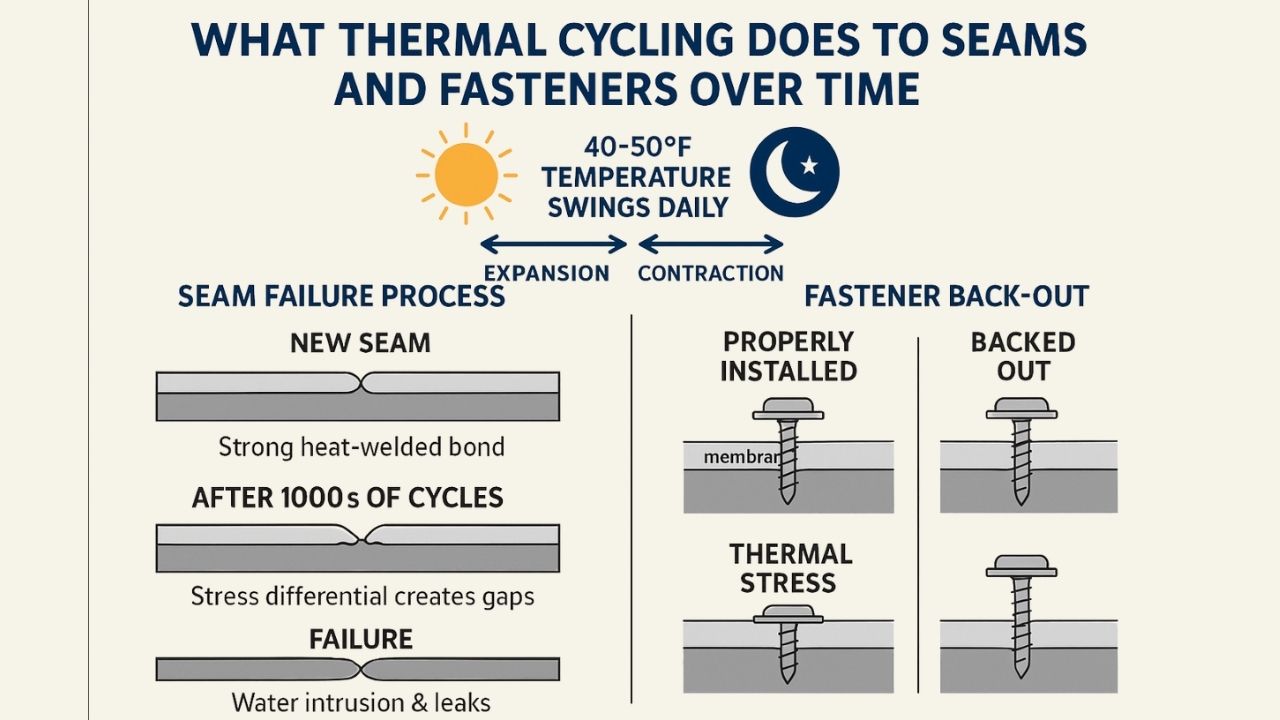
Thermal cycling creates stress points: This is the big one that most people don’t understand. Houston temperatures can swing 40-50 degrees between day and night. PVC expands in heat, contracts in cold. Every single day, your roof goes through this expansion-contraction cycle.
Do that thousands of times over years, and here’s what happens: seams start separating because the welded joint is experiencing constant stress, fasteners back out as the membrane pulls away during expansion cycles, membrane develops micro-cracks at stress points around penetrations, and areas with ponding water show accelerated degradation.
Unfortunately for PVC roofs in Houston, they haven’t been fortunate. They’ve had a pretty rough life.
Why 20-Year Warranties Often Fail at 10-14 Years Here
Here’s something most contractors won’t tell you: That 20-year warranty on your PVC roof? It’s based on average climate conditions, not Houston conditions.
Now, the TPO guys aren’t going to want me to say this, but usually a lot of times with these TPO and PVC roofs, they’ll start petering out on you at about 10 to 14 years here in Houston. It’s almost always a 20-year warranty, but it hardly ever lasts 20 years in this climate.
I don’t mess with PVC roofs much. I’m a TPO guy myself. I don’t have much use for PVC because I’ve seen a lot of them doing exactly what that downtown Houston roof was doing—coming apart at 12-15 years when they should have had another 5-8 years of life left.
Here’s what typically happens on the timeline:
Years 1-5: Roof performs well. Minor issues might appear but nothing major. Building owners think they made a good investment.
Years 6-10: First signs of trouble. Seams start showing separation. Fasteners begin backing out. Those spiral defects start appearing. Small leaks develop, usually after heavy rains.
Years 10-14: Major problems emerge. Multiple leak points. Extensive seam failure. Membrane brittleness becomes obvious. Building owners start getting quotes for repairs or replacement.
Years 15-20: If the roof makes it this far in Houston, it’s usually heavily patched and limping along. Full replacement or restoration becomes necessary.
The warranty says 20 years. Houston says 10-14 years. That’s just the reality of this climate.
From Chad Roesti, Construction Manager (verified Google review): “Chris was an absolute professional. He came and gave us quotation, sent to us in an email with pictures describing the issues and what he will do to repair it. We had received three quotations from three different contractors and Chris was the only one who did not try to tack on an additional unneeded items. The damage was more extensive then the original diagnosis. As a construction manager, I work with contractors everyday and I can attest that Chris is exactly what you are looking for in a contractor. Honest, experienced, and trustworthy.”
What Thermal Cycling Does to Seams and Fasteners Over Time
On that downtown Houston roof, I found over 8,000 feet of seams showing signs of failure or at risk of failing. That’s more than a mile and a half of potential leak points.
Seams are the Achilles heel of any single-ply roof system. And thermal cycling is their worst enemy.
Here’s what happens:
Seam separation mechanics: PVC roofing seams are created by heat-welding two pieces of membrane together. When done properly, this creates a bond stronger than the membrane itself. But that’s when the membrane is new and flexible.
As the roof ages and goes through thousands of thermal cycles, the membrane around the seam becomes less flexible while the seam itself remains relatively strong. This creates a stress differential. During expansion cycles (heat), the less-flexible membrane can’t expand as much as it wants to, creating tension at the seam. During contraction cycles (cold), the membrane pulls away from the seam.
Over time, this repetitive stress causes micro-separations that grow into visible gaps. Water finds these gaps. Leaks develop.
Fastener back-out: Mechanically-attached PVC roofs use thousands of fasteners to secure the membrane to the deck. Each fastener goes through the membrane and into the structural deck below.
During thermal expansion, the membrane tries to move but the fasteners hold it in place. This creates stress around each fastener location. Over thousands of cycles, the membrane can actually pull the fasteners partially out of the deck—what we call “fastener back-out.”
Once fasteners back out, you get: water intrusion around the fastener location, additional stress on surrounding fasteners (creating a cascading failure pattern), and membrane billowing or movement during wind events.
Penetration failures: Every penetration through your roof—pipes, vents, HVAC equipment—is a potential failure point. The membrane around these penetrations can’t move freely during thermal cycles because it’s constrained by the penetration itself.
This is why you often see leaks around penetrations first. The membrane is experiencing maximum stress in these locations, and thermal cycling accelerates failure.
On the downtown Houston roof, I found punctures and failures around every penetration. Not because they were installed wrong necessarily, but because 10-15 years of thermal cycling in Houston’s climate had taken its toll.
The Ponding Water Problem Nobody Talks About
Here’s something else that makes Houston particularly brutal for PVC roofs: flat commercial roofs and Houston rain don’t play nice together.
Commercial roofs are supposed to have positive drainage, water flows to drains and off the roof. But over time, several things happen: roof decks deflect under load, insulation compresses in high-traffic areas, and membrane stretching creates low spots.
The result? Ponding water—areas where water sits for 48+ hours after rain.
Houston gets serious rain. When we get a heavy storm, these roofs hold a lot of water. I watched one drain on that downtown Houston roof and found 20+ punctures around it. That drain probably ponds a little bit during big rains.
Here’s why ponding water accelerates PVC roof failure:
Constant UV exposure through water: Water doesn’t protect the membrane from UV—it actually magnifies it. The membrane under ponding water is getting hammered by UV rays even more intensely than dry areas.
Temperature cycling extremes: Water heats up during the day and cools down at night, creating even more extreme temperature differentials than dry membrane experiences.
Chemical degradation: Standing water accelerates chemical breakdown of plasticizers and other membrane components.
Biological growth: Algae and other organic growth can develop in ponding areas, creating additional degradation pathways.
The scary part about ponding water failures is they’re often hidden. You might have a ponding area with 10-15 micro-failures that only leak during really heavy rain events. The rest of the time, the roof looks fine.
That’s why systematic inspection matters. You can’t just look at the obvious problems.
What You Should Do If You Have a PVC Roof in Houston
If you’re managing a commercial property with a PVC roof in Houston, here’s your action plan:
If your roof is 0-7 years old: Schedule annual inspections to establish baseline condition. Document any early signs of spiral defects or seam issues. Keep drains clear and address small problems immediately. Start budgeting for restoration around year 10.
If your roof is 8-12 years old: Increase inspections to twice annually. Watch closely for seam separation and fastener back-out. Consider a comprehensive assessment to determine if restoration makes sense now or in 1-2 years. Don’t wait for leaks—be proactive.
If your roof is 13+ years old: Get a comprehensive assessment immediately. You’re in the high-risk zone for major failures. Determine whether targeted repairs, full restoration, or replacement makes the most financial sense. Factor in your building’s long-term plans when making this decision.
If your roof is already leaking: Stop the reactive patch cycle. Get a systematic inspection that identifies all problem areas, not just the obvious leaks. Design a comprehensive repair or restoration scope that addresses root causes. Don’t throw good money after bad with incomplete repairs.
From Amy Mayer (verified Google review): “Chris, owner of Commercial Roof Repair Solutions, REALLY took care of our flat roof issues. He ended up having to come out THREE times (before and after a storm then after another storm) and he STILL only charged us for the first visit. You just get a good feeling about some people, and we have it about him. He’s a good, honest guy and he’s our go to roof guy from now on. Highly recommend!”
Why Silicone Restoration Makes Sense for Houston PVC Roofs
I’ve been working for myself for 7 years, been with Everest for six and a half of it. I use a lot of their products for my restorations and repairs because they perform exceptionally well in Houston’s climate.
Here’s why silicone over PVC is one of the best decisions you can make:
Superior UV resistance: Unlike PVC, silicone doesn’t break down under UV exposure. It stays flexible and protective year after year, even under Houston’s intense sun.
Handles thermal cycling: Silicone expands and contracts with the roof without losing adhesion or developing cracks. It’s designed for thermal movement.
Ponding water resistance: This is huge. Premium silicone actually performs better when submerged in water. Perfect for Houston’s flat commercial roofs that deal with ponding.
Seamless protection: Once applied, silicone creates a monolithic membrane over your existing PVC roof. No seams to fail. No weak points. Just one continuous protective layer.
Cost-effective: A full silicone restoration system adds 10-15 years of life to your existing roof for 30-50% of replacement cost. You could come in about 13, 14, 15 years on a roof that maybe wasn’t installed right or has numerous repairs and do this and seal it with a full restoration. I’m really confident that as long as you put the right mills of that particular product down, you’re going to get a hell of a lot more—10 years out of it, easy.
Silicone on top of these PVC roofs is a lights-out roof. It’s one of the best performing roofs your money can buy, I promise you. It’s a fraction of the price and it’s going to extend the life of your roof and probably make it perform better than what it originally was.
Frequently Asked Questions About PVC Roofs in Houston Weather
How can I tell if my PVC roof damage is from Houston weather or actual hail?
The honest answer is: you probably can’t tell just by looking. Both create similar circular marks on the roof surface. However, spiral defects from weather degradation typically appear in uniform patterns across large sections of the roof, while hail damage is randomly distributed. Spiral defects also tend to appear on roofs that are 7-12 years old, even if there hasn’t been a recent hail event.
The best way to know for sure is to have an experienced commercial roofing contractor who’s seen both conditions inspect your roof. At Commercial Roof Repair Solutions, we’ve inspected hundreds of PVC roofs across Houston and can usually tell within minutes whether you’re dealing with weather impact or material defect issues. We’ll document everything with photos and give you a straight answer not whatever answer gets us the biggest contract
Is there anything I can do to make my PVC roof last longer in Houston’s climate?
The honest answer is: you probably can’t tell just by looking. Both create similar circular marks on the roof surface. However, spiral defects from weather degradation typically appear in uniform patterns across large sections of the roof, while hail damage is randomly distributed. Spiral defects also tend to appear on roofs that are 7-12 years old, even if there hasn’t been a recent hail event.
The best way to know for sure is to have an experienced commercial roofing contractor who’s seen both conditions inspect your roof. At Commercial Roof Repair Solutions, we’ve inspected hundreds of PVC roofs across Houston and can usually tell within minutes whether you’re dealing with weather impact or material defect issues. We’ll document everything with photos and give you a straight answer, not whatever answer gets us the biggest contract
Is there anything I can do to make my PVC roof last longer in Houston’s climate?
Yes, several things can extend the life of a PVC roof in Houston’s harsh climate. Regular maintenance inspections (at least twice a year) catch small problems before they become major failures. Keeping drains clear and ensuring positive drainage eliminates ponding water issues. Addressing seam separations and small punctures immediately prevents them from becoming major leak points.
Most importantly, consider a silicone restoration system once your roof hits the 10-12 year mark. Silicone coating creates a protective barrier over the PVC membrane that resists UV degradation, handles thermal cycling better than PVC, performs excellently in ponding water, and adds 10-15 years of life to your existing roof for a fraction of replacement cost.
I’ve done this for 17 years, and I’ve had probably seven or eight of these PVC roofs that we’ve restored. Matter of fact, I’ve got one right around the corner on Clinton Avenue that we fixed last year. Silicone on top of these PVC roofs is a lights-out roof. It’s one of the best performing roofs your money can buy.
My PVC roof is only 10 years old but already showing problems. Is this normal in Houston?
Unfortunately, yes. In Houston’s climate, it’s more common than it should be. Most PVC roofs in Houston start showing problems between 8-14 years, with seam failures and membrane degradation being the primary culprits. The combination of extreme UV, thermal cycling, humidity, and ponding water creates a perfect storm for accelerated aging.
The good news is that a 10-year-old PVC roof showing problems doesn’t necessarily mean you need a full replacement. A properly executed restoration system can add another 10-15 years of life to that roof for 30-50% of replacement cost. The key is catching problems systematically and addressing root causes, not just patching obvious leaks as they appear.
What’s the difference between how PVC performs in Houston versus other climates?
The difference is dramatic. A PVC roof in Minnesota or Seattle might easily reach its 20-year warranty life because those climates are much gentler. Cooler temperatures mean less thermal stress. Lower UV exposure means slower plasticizer degradation. Lower humidity means better drying when moisture does get in.
Houston has none of those advantages. We have year-round intense UV, daily temperature swings of 40-50 degrees, humidity that prevents drying, and heavy rain events that create ponding water. A roof that would age one year per calendar year in a mild climate might age 1.5-2 years per calendar year here.
That’s why you see so many PVC roofs in Houston failing at 10-14 years when they’re rated for 20. The warranty doesn’t account for extreme climate conditions.
Should I avoid PVC roofs entirely in Houston?
Not necessarily, but you should go in with realistic expectations. PVC roofs can work in Houston if you commit to aggressive maintenance, plan for restoration around year 10-12 rather than waiting for failure, and budget for actual lifespan of 12-15 years rather than the 20-year warranty.
Personally, I’m a TPO guy myself. I don’t have much use for PVC because I’ve seen a lot of them doing exactly what that downtown Houston roof was doing. But if you already have a PVC roof, don’t panic—just be proactive about maintenance and consider restoration before problems become severe.
The worst thing you can do is ignore early warning signs and wait until you have major failures.
Final Thought: Houston Weather Doesn’t Have to Win
Houston’s climate is tough on PVC roofs. That’s just reality. The combination of UV exposure, thermal cycling, humidity, and heavy rain creates conditions that accelerate aging and failure.
But that doesn’t mean you’re helpless. Understanding what’s happening to your roof—those spiral defects aren’t hail, that seam separation is from thermal stress, those punctures around drains are from ponding water, gives you the knowledge to make smart decisions.
You can be proactive with maintenance. You can catch problems early. You can restore your roof before major failures occur. You can extend the life of your roofing investment by 10-15 years for a fraction of replacement cost.
Or you can do what most building owners do: ignore the early warning signs, patch problems reactively as they appear, and end up spending more money on repeated repairs than a proper restoration would have cost.
So if you’ve got a PVC roof in Houston, give me a call, folks. I can save you a lot of money and I can make your assets last a lot longer.
About The Commercial Roofing Specialist

Chris Jokerst – Houston’s Trusted Commercial Roof Repair Specialist
When it comes to protecting your business, your roof isn’t just another structure—it’s your first line of defense. For over 16 years, Chris Jokerst, owner of Commercial Roof Repair Solutions in Houston, TX, has built a reputation as a true expert in commercial roofing repair and roof restoration.
With millions of square feet of commercial roofing systems installed and countless repairs completed, Chris has earned the trust of property owners and managers across Houston and beyond.
Experience That Speaks for Itself
Chris began his career the old-fashioned way—by learning from seasoned roofing professionals and putting in years of hands-on work. From apprenticeships to leading major projects, he developed a deep understanding of what makes a roofing system last. Today, he brings that same dedication to every job, whether it’s a small leak repair or a full commercial roof replacement.
Why Houston Businesses Choose Chris
* Proven Expertise: 16+ years specializing in commercial roofing repair and roof restoration.
* Dependability: Fast, effective solutions that minimize downtime and prevent costly damage.
* Honesty & Integrity: Transparent recommendations with your best interest in mind.
* Quality First: Only the highest-grade materials and modern techniques.
Chris understands that a roof leak is more than an inconvenience—it’s a threat to your business operations and bottom line. That’s why he approaches every project with precision, urgency, and a commitment to excellence.
Questions about your roof? Call Commercial Roof Repair Solutions at (281) 928-4428 for friendly guidance or a free, no-obligation quote.
